
Introducing Bleu_0.1
Many factories use robots, but each automation project is far more complex (and therefore costly) than it might initially appear. Current manipulators are primarily designed to repeat trajectories without variation or adaptation. For each workstation, engineers have three levers for automation: (1) limiting variability — for example, the position of objects to grasp — using accessories such as vibratory bowls and guides, (2) developing specialized vision-based algorithms to perceive this variability, and (3) developing task-specific grippers for each object (typically suction-based). Beyond hardware costs, this development process requires substantial engineering investment. This expense is only justified for tasks with high production volumes and minimal changes (product changes, process modifications, etc.). These automation costs explain why, to our knowledge, only a small percentage of tasks are fully automated in French & German factories.
Our analysis of industrial needs has clearly identified the value of "universal" robots that can be easily configured for many applications and replace a worker without requiring workstation modifications. The typical scenario we are targeting involves a bimanual wheeled robot (humanoid capabilities: mobility and bimanual manipulation) that learns a task either through teleoperation with a joystick or using manual grippers (see study 1), then reproduces it from demonstrations. A common factory example is machine loading: a worker must grasp a part from a bin or box, place it in a machine (e.g., a milling machine, laser engraver, or press), close the machine, press a button, wait for the result, then grasp the part, and position it in a new box. Typically, a factory operates several slightly different machines (different generations) and may change object types and sequences frequently based on orders (e.g., monthly). The critical scientific challenge is enabling robot training from demonstrations alone, as naturally as possible—without needing to manually sequence subtasks, scan objects for 3D meshes, train object classifiers, etc., as is currently required to automate a production line. In other words, the goal is to reduce automation costs to hardware and software costs only. This is fundamentally an imitation learning problem.
These tasks typically involve variability because they are designed for human workers (as opposed to fully automated production lines), who naturally adapt to variations—for example, objects or machines to manipulate are not always in the same position or orientation. Furthermore, if the robot moves, perfect positioning relative to objects and machines cannot be guaranteed (unlike a fixed robot). Computer vision and cameras are therefore necessary, not just "replaying" recorded trajectories.
The hardware—humanoid robots or wheeled humanoid robots—is almost ready: humanoid robots that cost less than USD 30,000 can now be purchased, and competition between manufacturers makes the robots more impressive every day.
What's missing is the right software to fulfill the needs of industrial tasks and, more generally, the vision of universal, flexible robots in factories. To achieve that, we need the right learning technology.
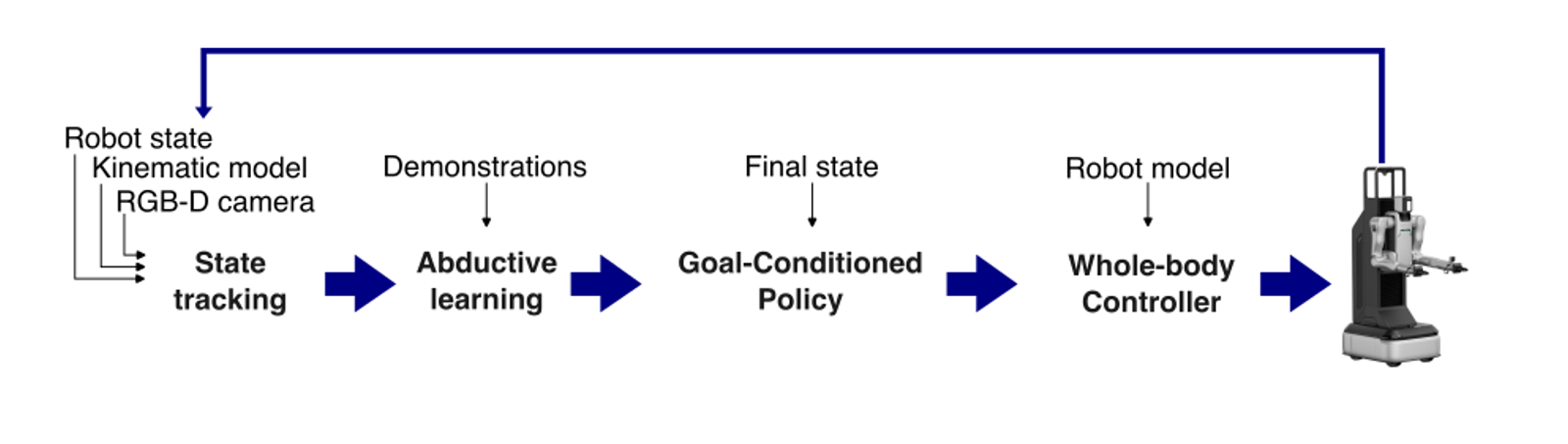
We have identified five critical characteristics for the learning system:
- Demonstration duration—and therefore the number of demonstrations—must be minimized because it often means stopping the production line (which is very costly) and/or requiring operators capable of performing the task. Tasks typically last 1–2 minutes, so 30 demonstrations already represent at least 30–60 minutes, excluding setup time. Most factory managers we contacted already consider this lengthy. As a consequence, we should aim for learning tasks with 10 to 50 demonstrations.
- Computation time for learning from data must also be minimized to reduce deployment time for new tasks. Waiting several hours to test the results of demonstrations is generally considered costly "downtime" that accumulates when tasks change frequently or when many tasks need to be learned.
- The robot must have two arms (a significant portion of tasks require both hands), a mobile torso, and the ability to move short distances (a few meters) to perform worker tasks without significantly modifying the organization. The goal is to make the robot's workspace, accounting for its mobility, resemble that of humans as closely as possible.
- Objects to manipulate cannot be known in advance and generally have shapes not found in standard datasets (e.g., internal engine parts, various mechanical components), making their automatic detection difficult.
- Industrial tasks are typically long sequences (at least 1–2 minutes, meaning at least 500–1000 time steps for a robot) with 5–10 different stages, distinguishing them from reactive control problems (e.g., trajectory following, walking, or maintaining a setpoint despite perturbations).
An overview of the Abductive Algorithm principle
The learning algorithm developed at Inria that led to the creation of Bleu Robotics builds on our experience with humanoid robotics learning(Rouxel, Ferrari, et al. 2024; Rouxel et al. 2025). We frame the imitation problem as a goal-conditioned reinforcement learning problem.
To minimize the number of demonstrations, we leveraged our experience with data-efficient learning algorithms. For example, we published an algorithm enabling a six-legged robot to relearn walking after damage in just 2 minutes (about ten trials) (Cully et al. 2015). We summarized our vision, including imitation learning, in a review article (Chatzilygeroudis et al. 2019).
Our analysis is based on understanding the sources of prior knowledge versus knowledge acquired from data. Imagine a horizontal axis representing the quantity of data, with different distributions between data and prior knowledge:
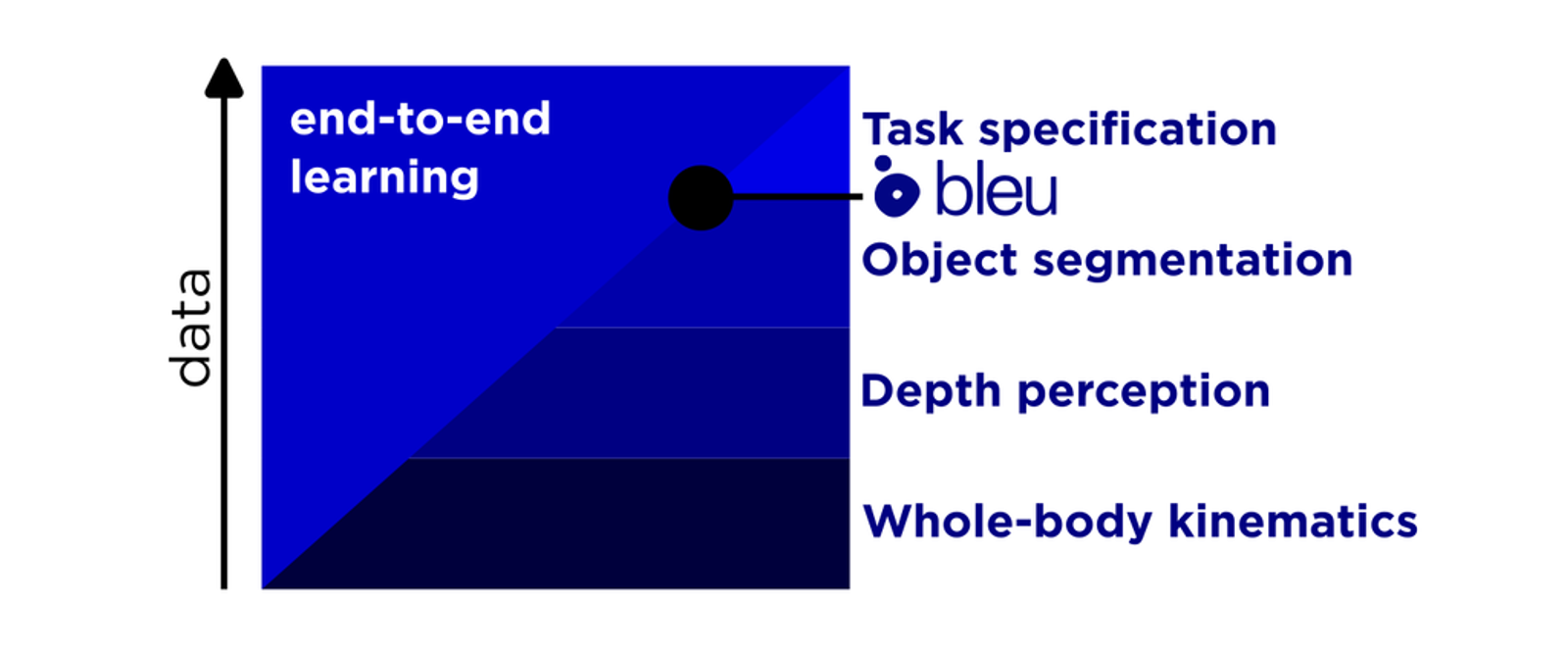
On the left extreme, everything is learned from data. This corresponds to "end-to-end" methods that take raw data and must learn everything from that data alone. For a robot, this means rediscovering concepts like perspective, 3D vision, objects, robot kinematics, gravity, etc. While it seems possible to acquire all this knowledge solely from data, such data must necessarily be in very large quantities. At the opposite extreme, on the right, we assume the system knows everything: object positions, dynamics rules, obstacles, etc. In this case, finding the optimal action sequence is an optimal planning (or optimal control) problem. It is simpler to solve, but a robot rarely has this complete knowledge. For example, in learning from demonstration, the task to perform is not known in advance. This view is similar to the classic nature/nurture debate: what is innate does not need to be learned from data.
To learn with little data, we must carefully balance the amount of prior knowledge and learning to only learn what is not known in advance and must therefore be learned from data. In the Bleu Robotics framework, this translates to:
- We assume the robot can determine object positions in 3D through a combination of depth cameras (RGB-D), such as RealSense, and pre-trained object tracking models like SAM2 (Ravi et al, 2024 - Meta) and FoundationPose (Wen 2024 - Nvidia). We have a functional prototype of this type of tracking.
- We assume the robot can be controlled in Cartesian space (x, y, z, rotation) rather than via its joints, using a whole-body controller(Rouxel, Ivaldi, et al. 2024; Penco et al. 2020; Dalin et al. 2021).
Using object positions does not work for all cases—for example, tracking fabric is very difficult—but covers the majority of industrial needs. This shifts one difficulty to the vision algorithm for tracking objects, but this is a problem where significant progress has been made and abundant data is available. Crucially, using positions (state space) rather than images requires an order of magnitude fewer demonstrations (Tao et al., 2024).
Bleu Robotics' learning algorithm is based on a central idea that we call "abductive learning."
The inspiration for abductive learning comes from the history of science (Kuhn 1997). Until Copernicus, the prevailing view of the universe was based on the Ptolemaic system, with Earth at the center and the sun revolving around Earth. According to observations, planets followed complex trajectories in the sky, sometimes approaching Earth, without anyone understanding why. Copernicus was the first to realize there was a simpler explanation for the same data (Kuhn 1992): Earth and the planets revolving around the Sun.
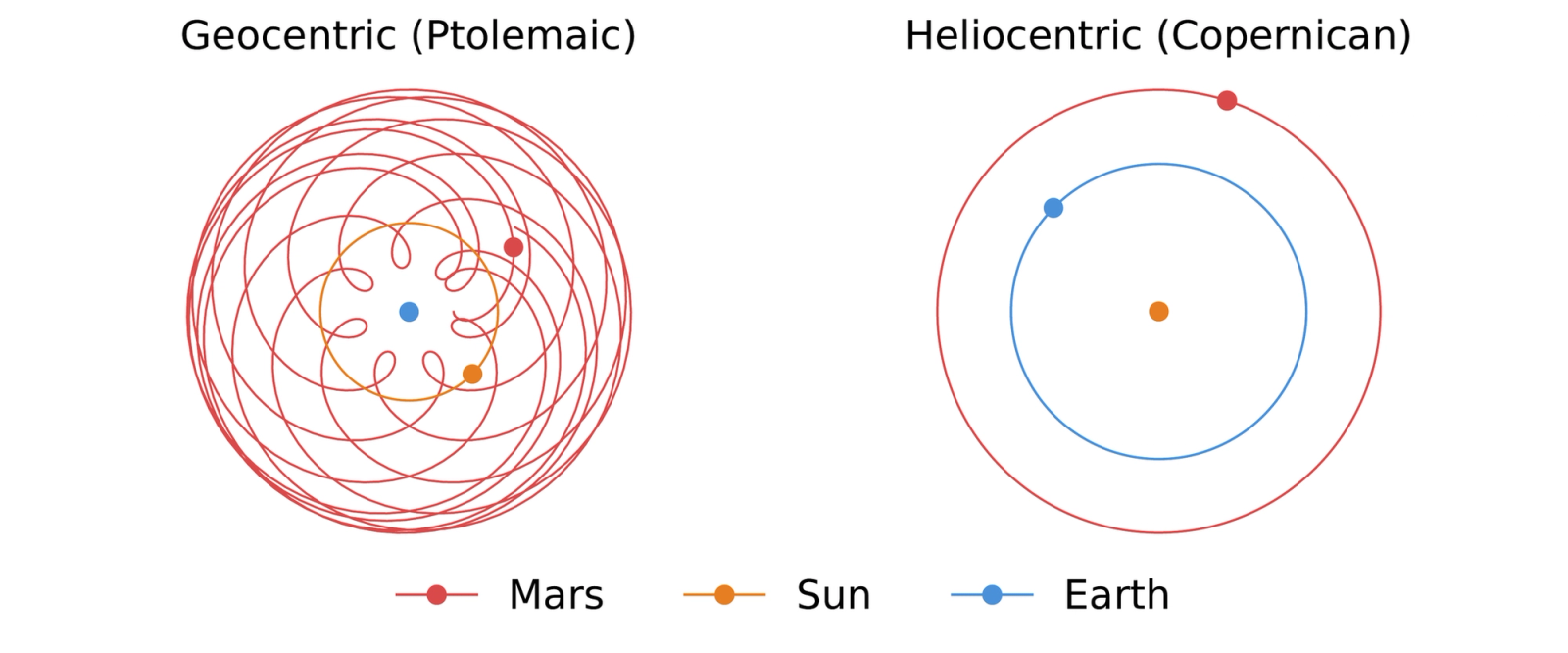
This type of reasoning, where a simpler explanation for the data is found, is called abductive reasoning, in contrast to deductive and inductive reasoning.
To make this difference concrete in machine learning, let's try a simple experiment with the data from our simplified solar system:
- end-to-end, black-box learning: learn a neural network that maps d ∈ [0, 1] (day) to (x , y )—this is what we typically do in machine learning
- end-to-end, better representation: it is well-known that a better input for neural network for periodic signals is to use (sin (d ), cos (d ))—this is what we can do with some understanding of the system
- heliocentric data (which is a simple frame change!), with (sin (d ), cos (d ))
- assuming we have an intuition that the data follow a circle, fit the parameters of a circle.
With the exact same data , we get the following result (the data corresponds to first 1/4 and last 1/4 of each year, and the test the remaining days):
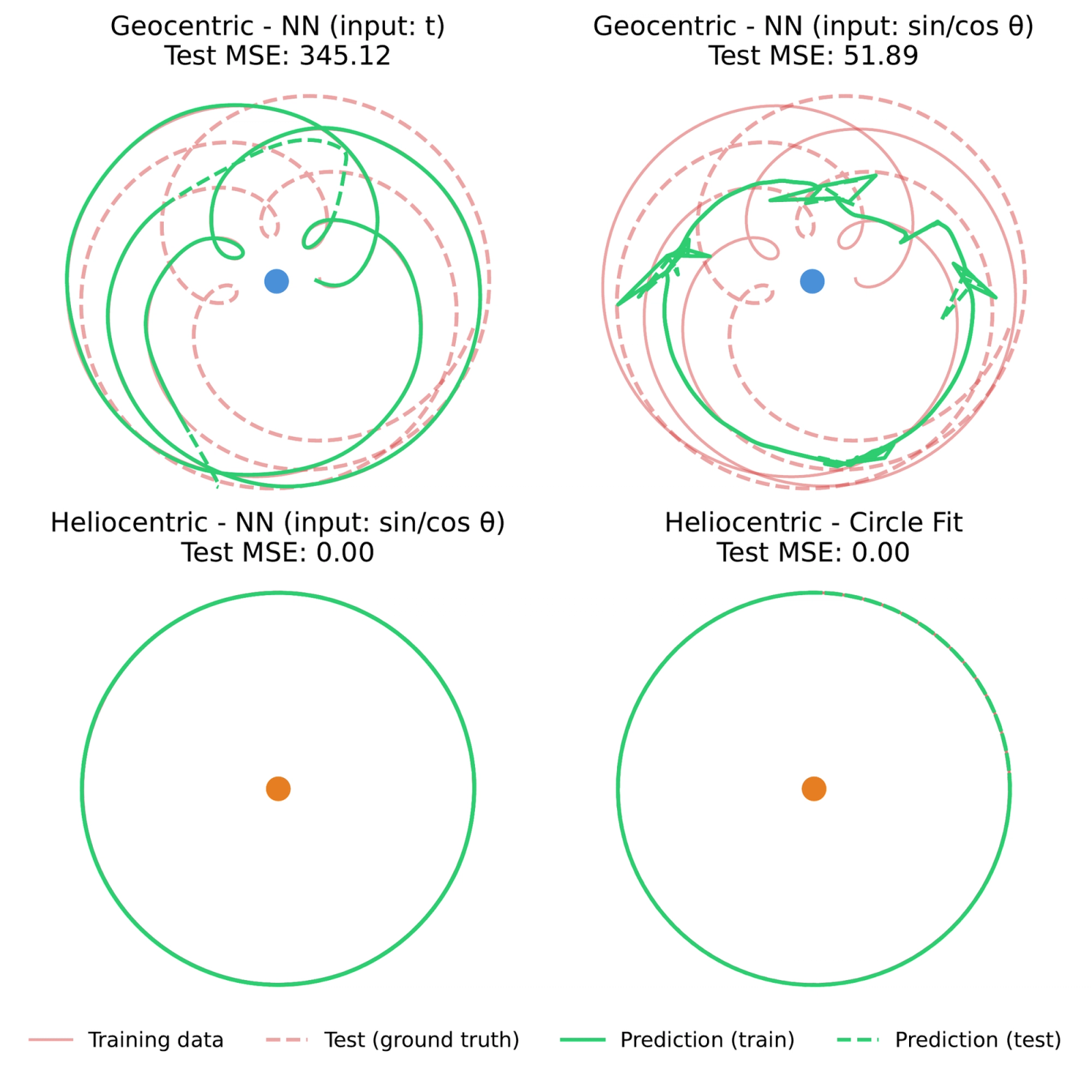
As is clearly apparent, the neural network with geocentric data fits the training set (as expected) but does not generalize (dashed line). Changing the input lowers the MSE, but the result is obviously wrong. By contrast, the heliocentric data fits perfectly, with the exact same neural network .
The algorithm we developed follows the same idea as Copernicus: from apparently complex geometric data, it seeks to express them differently. This makes the algorithm particularly data-efficient because a few demonstrations allow it to generalize.
Introducing Bleu_0.1
Bleu_0.1 represents a departure from traditional robotics and current end-to-end AI trends. It is a hardware-agnostic foundational model that enables robots to master industrial tasks with unprecedented speed and reliability.
The Bleu algorithm is built on three transformative technical pillars:
- Few-Shot Imitation Learning: Unlike standard AI models that require massive datasets or days of fine-tuning, Bleu is not pre-trained and can learn a new industrial task in less than one hour. By showing the robot a task less than 10 times, it can perform the task autonomously.
- Robot-agnostic: Working with any robot that communicates via the ROS standard, integrating a new robot model is highly efficient. This allows the AI to function across diverse platforms, from industrial arms to advanced humanoid models like the Unitree G1.
- Industrial Robustness: The architecture is specifically designed for cyclical, repetitive factory tasks. It is natively robust to changes in lighting, object position, and orientation, ensuring it remains reliable even when the production environment shifts slightly.
Our policy is task-agnostic, therefore we deployed it on several hardware on several industrial -like tasks in the laboratory conditions. We demonstrate that our models is able to handle a large variety of different taks from very few demonstration without specific pre-training with 99.9X % of success.
Let’s take a look at some of these tasks.
- Drilling workstation : The goal is to load the machine with an unidentified items, grasp the lever and complete a full drilling cycle on a workpiece. This is a classic long-horizon task the robot must perform while adapting to changes in the items’s initial position. Despite the minimal data provided, the model learns the sequence, successfully navigating the mechanical constraints without any large specific pretraining. It demonstrates that even complex, multi-stage tool use can be mastered with very few examples. It runs on Unitree G1 and Franka Research 3
- Order Picking : The goal is to identify various workshop items, from spray cans to glue bottles and organize them into a neat storage bin. While simple "pick-and-place" is a robotics staple, doing so from a few demonstrations with a humanoid in a cluttered, varied environment is much harder: the robot must reason about the geometry of each object and the spatial constraints of the bin. Our model successfully handles a wide range of initial object distributions and bin positioning from 5 demonstrations. It also demonstrate mutli instance grasping.
Evaluating and comparing Bleu_0.1 to prior models
In the Maniskill3 benchmark tasks (Tao et al., 2024) we tested, a 98% success rate is achieved with fewer than 10 demonstrations, compared to at least a hundred for diffusion policy algorithms (Chi et al. 2025) using the same traning data, which represent the state of the art.
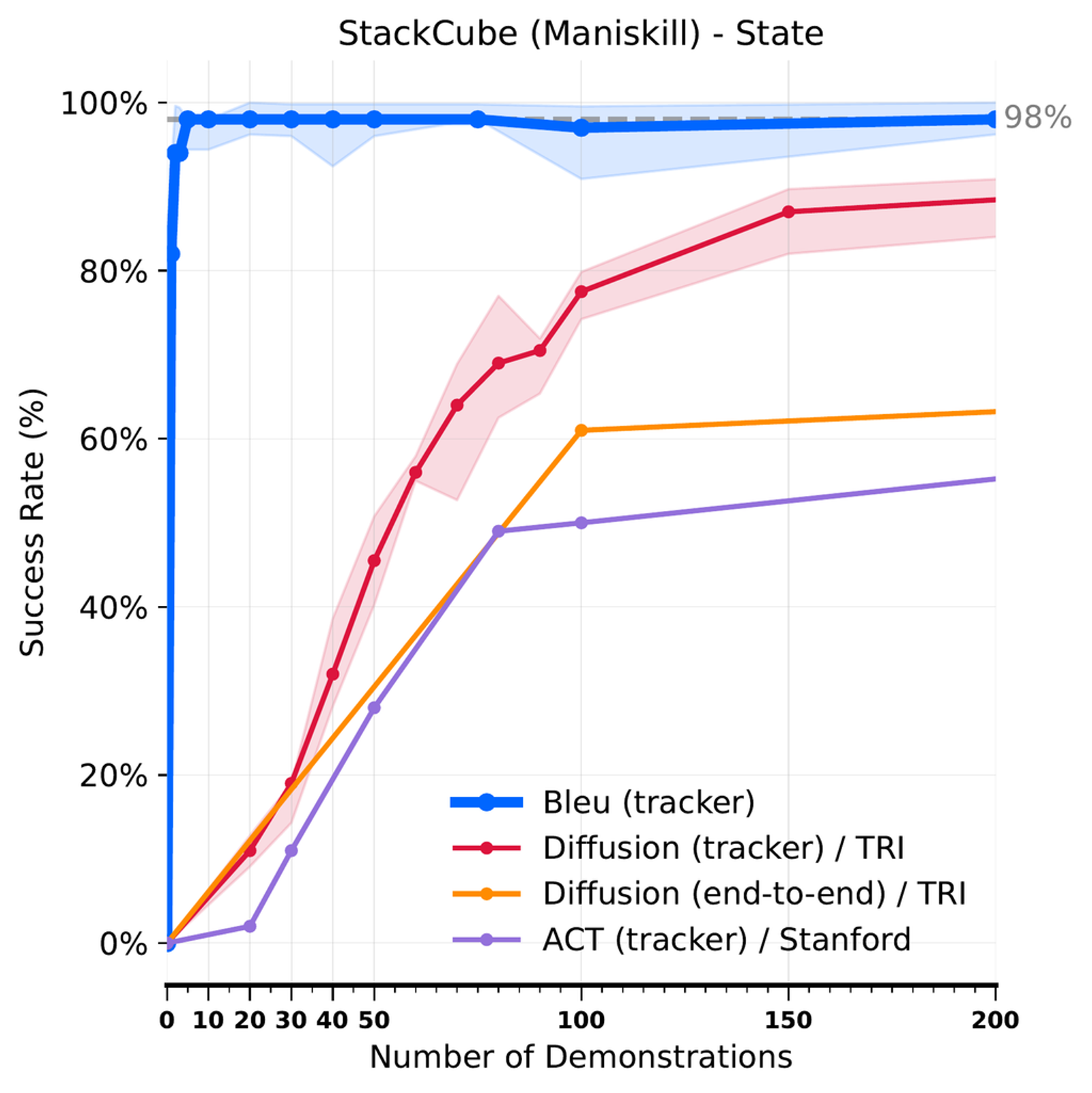
Figure: Success rate on the StackCube task in Maniskill3 simulation (Tao 2024), part of the imitation technique benchmark. In this test task, the robot must learn by demonstration to place one cube on another with randomized cube positions. The x-axis represents the number of demonstrations, which must be below fifty in industrial use cases. These initial results demonstrate the ability to learn with very few demonstrations compared to state-of-the-art techniques (diffusion policies).
Additionally, the algorithm we developed can learn long sequences, typically with more than 10 steps, whereas all our tests on the same data with diffusion were unsuccessful.
For example, in the task below, the robot must learn to open the door, grasp the cube, put it in the machine, close the door, and press the button. Our algorithm achieves 99% success and diffusion, using the same data, achieves 0%. Furthermore, Bleu Robotics’ abductive algorithm requires minimal computation, typically less than 2 minutes on a laptop, whereas diffusion on the same data requires 1-3 hours to converge.
The learning algorithm then synthesizes a policy capable of taking into account the goal and "generalized" demonstrations to achieve the target goal, typically the end of the sequence to execute.
Limitations
While Bleu 0.1 marks a breakthrough in industrial robotics, several key limitations remains and as to be overcome. The model is primarily optimized for rigid objects, as non-rigid materials like textiles remain outside our current focus. We also maintain a strict safety boundary: the system cannot generate "out-of-distribution" trajectories. This means that while the robot is prevented from making dangerous, unpredictable movements in a factory settings, it will stop if it encounters a situation it cannot recognize and will ask for help.
Where do we go from there ?
Building upon the foundational strengths of Bleu 0.1, notably its reliability, exceptional data efficiency, and robot-agnostic architecture, our immediate future work is dedicated to expanding its capabilities and accelerating its real-world deployment. Our next key development areas include the seamless integration of robot displacement, enabling the system to autonomously navigate and operate across multiple workstations. We are also actively researching and implementing Manipulation Interface teaching methodologies to further refine the demonstration process, aiming for even greater precision and speed. Concurrently, efforts are underway to improve the model's capacity for highly precise tasks, pushing the boundaries of fine-grained manipulation. A critical step will be the deployment of our technology in diverse real-world industrial conditions, allowing us to rigorously test and validate its reliability and adaptability at scale. Achieving these ambitious goals necessitates a multi-faceted approach: continuous technological improvement of our core algorithms, extensive real deployment on the field to gather invaluable empirical data, and, crucially, a collective effort from industrials, robotics companies, and integrators. This collaborative ecosystem is essential to foster the widespread adoption and continuous evolution of intelligent robotic solutions like Bleu 0.1, paving the way for a new era of flexible and autonomous manufacturing.
- Chi, Cheng, Zhenjia Xu, Siyuan Feng, et al. 2025. “Diffusion Policy: Visuomotor Policy Learning via Action Diffusion.” The International Journal of Robotics Research 44 (10–11): 1684–704.
- Cully, Antoine, Jeff Clune, Danesh Tarapore, et Jean-Baptiste Mouret. 2015. “Robots That Can Adapt Like Animals.” Nature 521 (7553): 503–7.
- Dalin, Eloïse, Ivan Bergonzani, Timothée Anne, Serena Ivaldi, et Jean-Baptiste Mouret. 2021. “Whole-Body Teleoperation of the Talos Humanoid Robot: Preliminary Results.” ICRA 2021 – 5th Workshop on Teleoperation of Dynamic Legged Robots in Real Scenarios .
- Kuhn, Thomas S. 1992. The Copernican Revolution: Planetary Astronomy in the Development of Western Thought . Harvard University Press.
- Kuhn, Thomas S. 1997. The Structure of Scientific Revolutions . Vol. 962. University of Chicago Press, Chicago.
- Penco, Luigi, Enrico Mingo Hoffman, Valerio Modugno, Waldez Gomes, Jean-Baptiste Mouret, et Serena Ivaldi. 2020. “Learning Robust Task Priorities and Gains for Control of Redundant Robots.” IEEE Robotics and Automation Letters 5 (2): 2626–33.
- Rouxel, Quentin, Clemente Donoso, Fei Chen, Serena Ivaldi, et Jean-Baptiste Mouret. 2025. “Extremum Flow Matching for Offline Goal Conditioned Reinforcement Learning.” 2025 IEEE-RAS 23rd International Conference on Humanoid Robots (Humanoids) .
- Rouxel, Quentin, Andrea Ferrari, Serena Ivaldi, et Jean-Baptiste Mouret. 2024. “Flow Matching Imitation Learning for Multi-Support Manipulation.” 2024 IEEE-RAS 23rd International Conference on Humanoid Robots (Humanoids) , 528–35.
- Rouxel, Quentin, Serena Ivaldi, et Jean-Baptiste Mouret. 2024. “Multi-Contact Whole-Body Force Control for Position-Controlled Robots.” IEEE Robotics and Automation Letters 9 (6): 5639–46.
- Tao, Stone, Fanbo Xiang, Arth Shukla, et al. 2024. “ManiSkill3: GPU-Parallelized Robotics Simulation and Rendering for Generalizable Embodied AI.” arXiv arXiv:2410.00425.