
Last update: 2026/11/20

Succeeding 200 times is not succeeding 20 times
17 min read
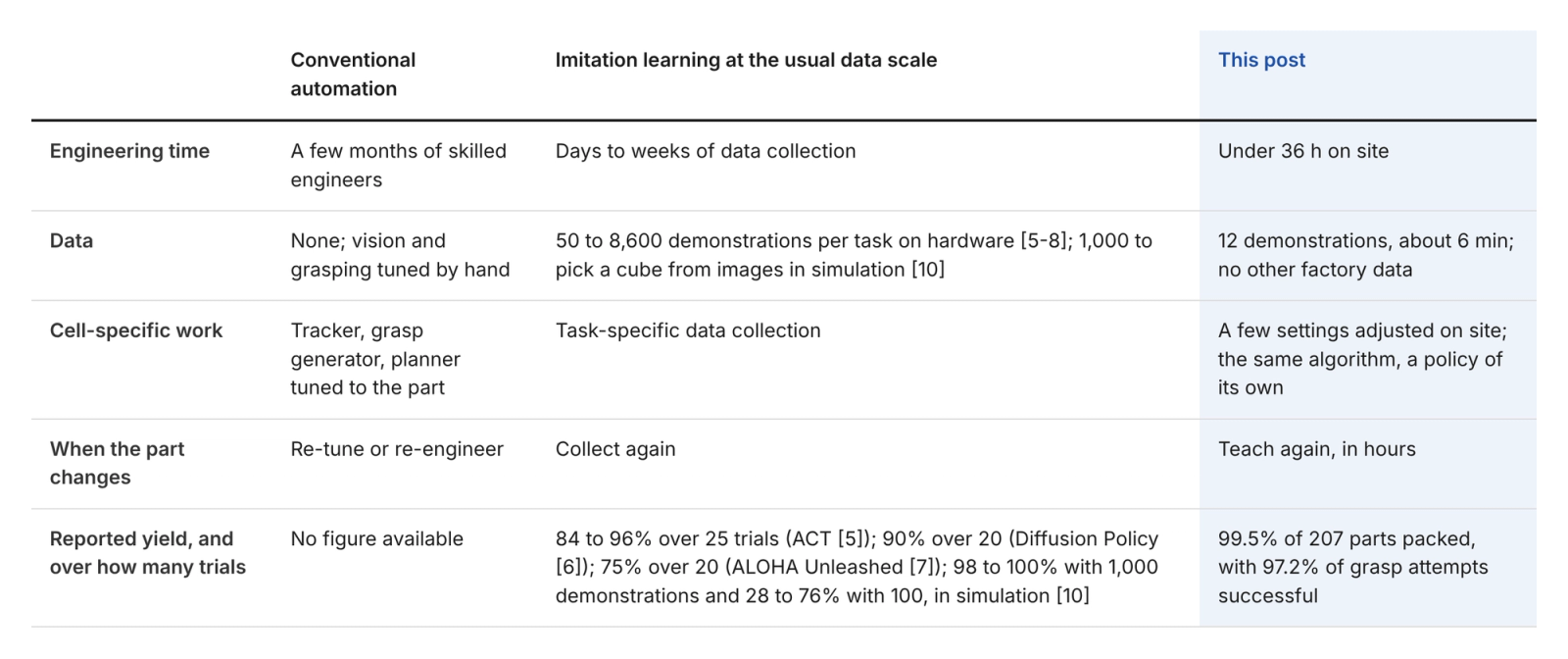
We taught a Unitree G1-D to pack plastic parts at the end of an injection moulding line of the Novares factory in Seseña, Spain, an operation done by hand on this line. We recorded 12 demonstrations at the line by teleoperation, about 6 min of data, and trained the robot's policy on site from them alone. We started the first packing trial 1.5 h after the first demonstration. Within 36 h of our arrival, we tested the robot over 65 min of production as it took each part off the outfeed conveyor and placed it in a Euro container before the part reached the end of the conveyor. The robot succeeded in 97.2% of its grasp attempts and, after a failed grasp, often had the time to try again before the part moved on, so that it packed 206 of the 207 parts and missed 1, an overall success of 99.5%.
Introduction
[ 01 / 11 ]
Bleu Robotics is an AI software company that is designing a learning system so that an operator can teach a robot a work-cell operation by demonstration.
Demonstrations recorded in factories are rare. They are costly to collect, because recording on a producing line usually means stopping it, and they cover few of the world's manufacturing operations. They are also a small part of the robot data a general model would need, which one estimate puts at 100,000 years of collection at current rates [4] and which may not be enough on its own [3].
We therefore design the algorithm to learn from little data. We aim to train a policy on less than 15 min of data and to have the cell producing 1 h after the first demonstration. Inspired by the "genchi genbutsu" of lean manufacturing [2], we take the algorithm to factories, where its requirements are set and its reliability can be measured.
The Novares factory in Seseña operates 40 moulding lines, each an injection moulding machine with its own take-out robot and outfeed conveyor. It produces a different part on each line and changes the parts with the orders, so it cannot pay back a cell engineered over months for one part before the part changes [1]. It needs a cell that can be taught a new part in hours and expect to successfully pack 99% or more of the parts produced on a line.
The line we worked on is a typical injection moulding line. At each shot, it lifts 4 parts out of the mould with its take-out robot, drops them on its outfeed conveyor and advances the conveyor by one group of 4. It delivers the parts not well aligned, with their position and orientation varying from shot to shot and every other row turned 180 degrees.
The robot has to grasp each part before the conveyor advances again and carries it off its end, and to place it in a Euro container, which an operator or another robot takes to the next station once it is full. It therefore works at the pace of the moulding machine.
Objective of the experiment
[ 02 / 11 ]
Conventional automation can pack these parts. It would use a fixed-base cobot, a fixed and calibrated vision system with a 6D, mesh-based pose tracker, a grasp generator and a motion planner, each tuned to this part, this conveyor and this machine. This kind of project would take an integrator's skilled engineers a few months and would cost 3 to 4 times the price of the robot at each cell [12].
Mainstream imitation learning algorithms can also undoubtedly learn the operation, if given enough demonstrations. In simulation, on the ManiSkill3 benchmark, Diffusion Policy picks a cube on a table in 100% of trials after 1,000 demonstrations and in 76% after 100 [10]. On hardware, ACT is reported by its authors to reach 84 to 96% with 50 demonstrations per task [5], and Diffusion Policy 90% with 100 to 200 [6]. ALOHA Unleashed, a diffusion policy with a transformer architecture close to that of ACT, reports 75% on the easiest task with 5,000 to 8,600 demonstrations [7]. In a fixed environment they gain little from more than about 50 demonstrations and level off near 90% [8]. They therefore need from 50 to several thousand demonstrations of each operation, more than a factory can record at every cell without stopping its lines. With these, they reach 75 to 96% on hardware, whereas a factory needs 99% or more; at 80%, they would let 1 part in 5 fall off the end of this conveyor, a yield of no use in most factories.
During these test days, we measured not whether the operation can be done but the time and the data it takes to reach a factory's yield. We kept the algorithm unchanged and gave it 12 demonstrations, about 6 min of data, with minimal cell-specific engineering. We measured the yield, the share of parts packed, against the 95% the factory had set for this first test and the 99% it requires in production, over the 207 parts of the 65-min trial.
In June, at Vivatech, a full Unitree G1 learnt a 6-step machine-tending cycle on a laser engraver from 6 demonstrations recorded on site the day before the show opened, with the same algorithm. It took a part from a box, placed it in the engraver, closed the door, pressed 2 buttons, opened the door and took the part out. It then tended the engraver for 4 days, more than 80 cycles a day, with the compute on site and no safety rope, crane or fall (Video 2). It worked through a long cycle with no time pressure, the opposite of the short, machine-paced packing cycle. It completed an encouraging 96% of its cycles over those 4 days, but it worked on a show floor rather than in a factory.
We use the same algorithm for every cell and purposely do not tune it with knowledge of the cell or re-engineer the line. For instance, we could probably make this cell faster by refining the trajectories for 3 weeks and tune every parameter, but we would bind the result to this specific operation. By doing so, we would move from generality towards assumptions on the spectrum that Eppner et al. called "generality vs. assumptions" in their lessons from the Amazon Picking Challenge [9]. We can instead apply the procedure used here unchanged at the next cell, and we pass every improvement to the algorithm on to every cell taught afterwards.
Moulding line and operation
[ 03 / 11 ]
The line moulds its plastic part in a 4-cavity mould, with a cycle of 74 s per shot (median) in the 1-hour trial and down to 50 s in other trials. It lifts the parts out of the mould with the suction cups of a top-entry Cartesian take-out robot.
The parts lie on the conveyor with every other row turned 180 degrees, because the mould holds its 4 cavities in 2 mirrored rows and the take-out robot keeps this layout. They must therefore be located by vision before each grasp.
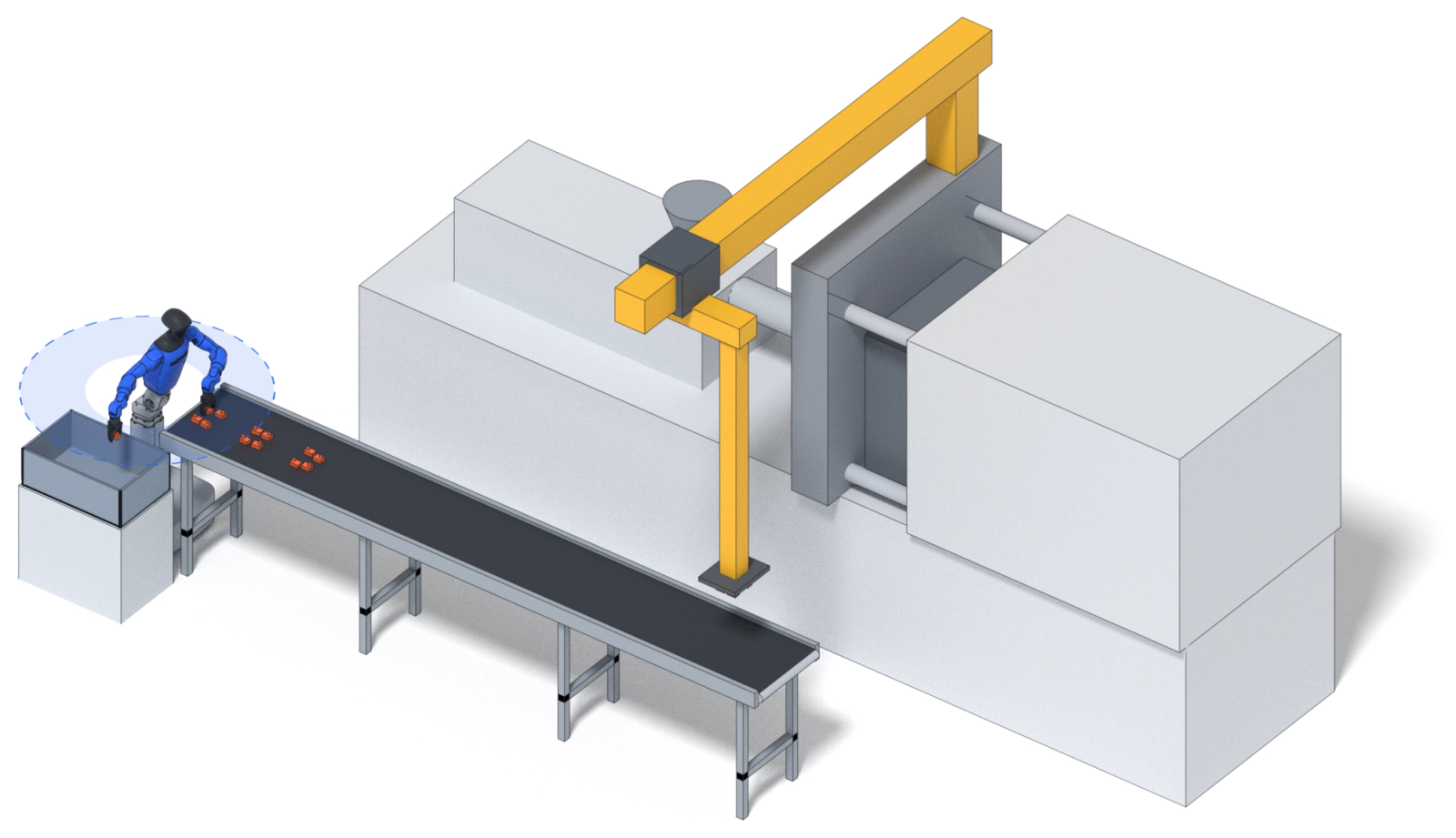
On this line an operator packs the parts by hand. Once the crate is full, the operator moves it onto a pallet and stacks it on the crates already there, ready for the assembly station where the parts are ultrasonically welded onto a larger part moulded on another machine.
We arrived at the factory at 10 am and spent the first hours understanding how this factory operates. We unloaded the robot and installed it at the end of the conveyor. We recorded the first demonstration at about 2 pm and tested the first policy 1.5 h later.
The robot that did most of the packing was a Unitree G1-D, the torso version of the G1 on a wheeled base. It stood fixed at the end of the conveyor and never used its wheels, because the cell needed only its arms and torso. It located the parts with a RealSense D435if depth camera on its torso and grasped them with Unitree Dex1 2-finger grippers, one on each arm.
One of our G1 robots, with legs, also packed parts at this line, for 15 min. It met several problems in this trial, including losses of balance, because it stood on a pallet to reach the height of the conveyor and the pallet was not a stable base. It also gained nothing from its legs, because the factory floor is flat and the cell stays in one place.
We measure the changeover of a robot cell as a factory measures a mould change. We count 1.5 h from the first demonstration to the first cycles, and we treat this interval as the changeover time of the cell, which is critical for this kind of industry [11]. We count less than 36 h from our arrival to the end of the 1-hour trial at a yield of 99.5%, and we are working to shorten this time.
Teaching by teleoperation
[ 04 / 11 ]
We recorded the 12 demonstrations at the line, by teleoperation during the first afternoon. Our engineer guided the robot's arms with our VR joystick-based teleoperation interface, watching the conveyor directly by standing next to the robot, and packed 1 part in each demonstration, in about 30 s. We recorded every demonstration with the conveyor at rest, and we covered both orientations of the parts (6 demonstrations each) and various positions. We collected about 6 min of data in total. We recorded the demonstrations with the parts of 3 shots on the conveyor, in 2 rows of 6, because we did not know then that the take-out robot could leave a single shot of 4 parts at the end of the conveyor, in 2 rows of 2. We ran the 1-hour trial with this second layout, with the factory's agreement.
The policy was trained on site, on a standard workstation with an RTX 5080, in under 5 min, with no step off site. It learnt from the 12 demonstrations and from no other data from the factory.
First trials
[ 05 / 11 ]
The robot packed its first parts 1.5 h after the first demonstration. The next afternoon, it packed for 36 min without interruption and missed 7 of 97 parts, a yield of only 93% (90/97).
A yield of 93% looks acceptable from the side of the line, where it leaves only a few parts on the floor. It falls short, however, of the 99% or more that the factory requires in production.
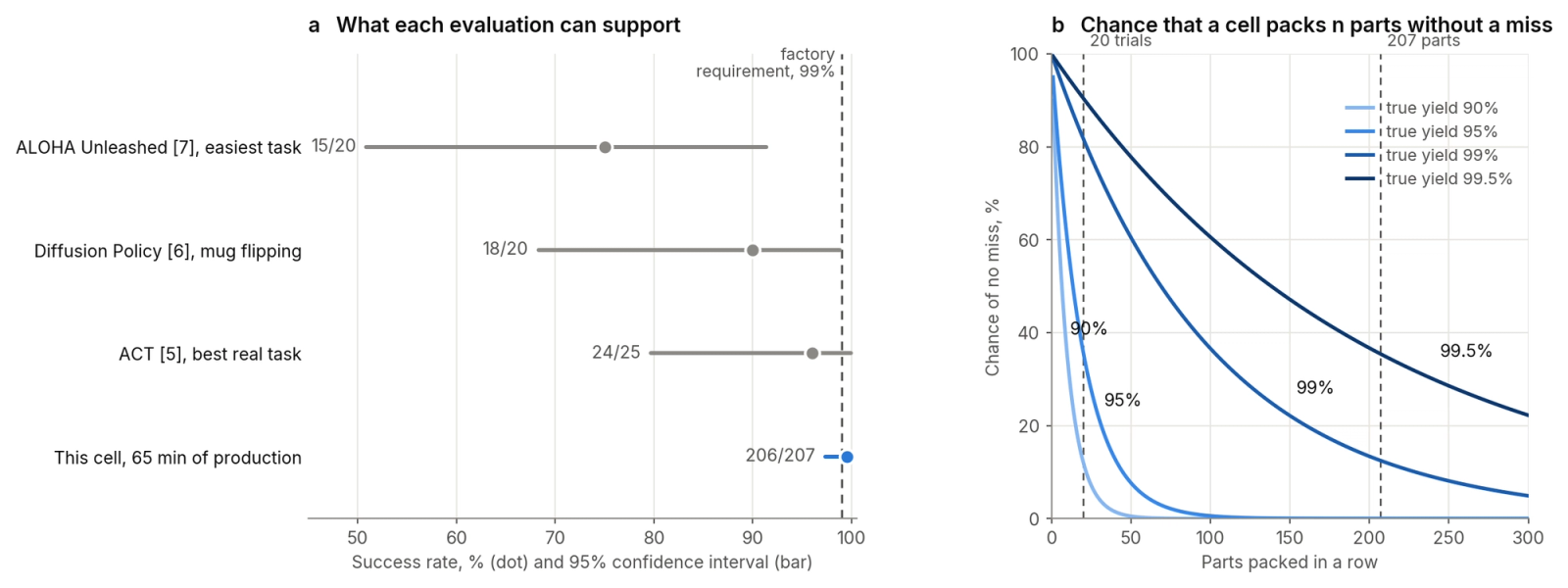
A short trial without a miss says little about the yield. After n parts with no miss, it bounds the failure rate only at about 3/n, with 95% confidence [13]. It also passes easily at 93%, since a process at that yield packs 20 parts in a row without a miss in 23% of 20-part trials ( = 0.23). It therefore cannot tell 93% from 100%, and it cannot replace an hour of production.
The 7 misses of the 36-min trial came with 2 problems:
- The robot overheated. While it waited for the next part, it held a pose that demanded too much torque from its shoulder motors, and it heated its right shoulder roll joint to 100 °C. It was losing some precision after about 23 min of continuous packing, until we had to stop it to avoid damaging the motor.
- A demonstration was sub-par. Of the 12 demonstrations, 1 showed a less reliable grasp.
In the 2 h before the next trial, we discussed these problems with the line's engineers. We removed the sub-par demonstration from the training set and retrained the policy on the other 11, in under 5 min. We also lowered the shoulder roll and shoulder pitch of the pose in which the G1-D waits for the next part, so that it demands less torque from its shoulders, and adjusted a few settings on the robot.
Results of a 1-hour trial
[ 06 / 11 ]
The same evening, the robot packed for 65 min without interruption (Video 6). (We stopped the robot after 65 min, once the trial had reached its goal of 60 min.) It succeeded in 207 of its 213 grasp attempts (97.2%). After 5 of the 6 failed grasps, it had the time to try again before the part moved on, so that of the 207 parts that reached the end of the conveyor, it packed 206 and missed 1, an overall success of 99.5% (206/207). It needed no new demonstration and used the 11 demonstrations left after the sub-par one was removed. It reached this overall success within 36 h of our arrival, with a new waiting pose that kept both its shoulders at or below 80 °C, a level they reached only after 49 min.
On a second visit 9 days later, the robot packed with the same 11 demonstrations and a waiting pose we had refined in between. It first worked through 2 trials of 87 and 36 min, which packed 97.7% and 98.9% of their parts, and we adjusted a few settings on the robot during the visit. It then packed for 97 min without interruption. It succeeded in 252 of its 258 grasp attempts (97.7%) and packed 252 of the 253 parts that reached the end of the conveyor, an overall success of 99.6%. It missed only a part that a person had handled and turned over, a pose that none of the demonstrations showed. Its hottest shoulder joint stayed at or below 72 °C, under the 80 °C warning, for the whole trial.
A measured yield is an estimate, and it means little without the number of parts behind it. Over 10 parts, it reaches 100% for a cell at 99% in 9 trials out of 10 ( = 0.90), and still in 1 trial out of 3 for a cell at 90% ( = 0.35). This means that a model that has a 90% yield, when evaluated with only 10 parts, has a 35% chance of being lucky and reported at 100%. Overall, the yield varies from one trial to the next by about √(p(1 − p)/n) when the cell packs each of n parts with probability p, independently of the others, because the number of misses then follows a binomial distribution. Over 10 parts at 90%, it therefore varies by about 9 percentage points, and over 207 parts at 99.5% by about 0.5 point.
The Clopper-Pearson interval takes both numbers into account and is the classical confidence interval for a yield [14, 16]. It collects the true yields that the observed number of misses does not reject at a chosen confidence, and it computes its bounds exactly from the binomial distribution (Box 1). At 95% confidence, it gives 10 parts without a miss an interval of 69 to 100%, which contains both 90% and 99%. It gives a team that reports 95% over 20 trials (19 successes) an interval of 75 to 99.9%, since a cell whose true yield is only 80% still succeeds 19 or 20 times in 7% of such 20-trial evaluations, and a cell at 90% in 39% of them. It narrows to 98.2 to 100% for 200 parts without a miss. The independence it assumes is optimistic for a robot that drifts, as the overheating in the 36-min trial showed, and only longer trials can check it.
How the Clopper-Pearson interval is computed
[ 07 / 11 ]
For k successes in n trials, the interval at confidence collects the true yields that the observation does not reject [14, 16]. Its lower bound is the yield at which k or more successes occur with probability , and its upper bound the yield at which k or fewer occur with probability :
It is also written with the quantile function of the beta distribution, and , which most statistics libraries provide; for 206 successes in 207 parts, scipy.stats.beta.ppf(0.025, 206, 2) and scipy.stats.beta.ppf(0.975, 207, 1) return 0.9734 and 0.99988. It has closed forms at the extremes. With no miss, , so 20 successes out of 20 give ; with 1 miss, , so 206 successes out of 207 give , and solves . It is conservative, because the binomial distribution is discrete, and its coverage is at least 95% whatever the true yield [16].
Our hour of production gives an interval of 97.3 to 99.99% at 95% confidence. It shows that the true yield of the cell is above 97.3%, and it bounds the failure rate below 2.7%, but it cannot show that the yield is above 99%. It would have needed about 300 parts without a miss to do so, because a cell at 99% packs 300 parts in a row without a miss only 5% of the time ( = 0.05). It therefore calls for a longer trial, of at least 300 parts.
An evaluation of 20 trials, a common size in robot-learning papers [15], supports much less. It gives the 90% reported for Diffusion Policy (18/20) an interval of 68 to 99% [6], and the 96% of ACT on its best real task (24/25) an interval of 80 to 99.9% [5]. It leaves the true yield anywhere above 83% even when all 20 trials succeed (Figure 2a). It also passes too easily, because a cell at 90% completes 20 trials without a miss 12% of the time and a cell at 95% 36% of the time (Figure 2b).
Quality engineering reports a yield on another scale, the sigma level of the Six Sigma convention [17]. It models the misses as the tail of a normal distribution beyond a specification limit, counts the standard deviations (sigma) between the mean of the process and that limit, and adds the 1.5 sigma by which the convention assumes a process drifts over time. It thus gives a yield y the sigma level Φ⁻¹(y) + 1.5, where Φ⁻¹ is the quantile function of the standard normal distribution. It places the 36-min trial (93%) at about 3 sigma and our hour of production (99.5%) at about 4 sigma, or 3.4 sigma at the lower bound of its interval (97.3%).
Yield required in production
[ 08 / 11 ]
The factory judges the cell by the yield of the whole line, not by that of the robot alone. It multiplies the yields of the steps along the line. If its machine moulds 95% good parts, it delivers 90% of the parts to the assembly station with a packing cell at 95% (0.95 × 0.95 = 0.90), against 95% with an operator, who practically never misses a part. It therefore requires 99% or more from the packing cell, whatever its speed, so that packing costs the line less than 1 point of yield. At about 200 parts per hour, it would lose 160 parts in an 8-hour shift with a cell at 90%, 16 with a cell at 99% and 8 with a cell at 99.5%.
Lessons learned
[ 09 / 11 ]
- A real factory is not our lab, but our code was robust enough to work there without adaptation. The cell worked under the factory's lighting, beside a producing machine and at the takt time that machine imposes.
- High success rates are possible from only 12 demonstrations. The cell packed 206 of 207 parts with a policy trained on 11 of the 12 demonstrations, about 6 min of data in all, with minimal cell-specific engineering and the algorithm we use at every cell.
- A trial of 20 parts cannot tell 93% from 100%. A cell at 93% completes 20 parts without a miss 23% of the time, whereas 207 parts with 1 miss bound the failure rate below 2.7%.
- Reliability is the first gate. The cell reached the 99% the factory requires in production, because the yields of a line multiply. It packed its first parts 1.5 h after the first demonstration and reached 99.5% within 36 h of our arrival, and a factory with 40 lines on parts that change with the orders pays for the time to reach its yield, which we are working to shorten.
Next steps
[ 10 / 11 ]
In March we set out to validate the reliability of the algorithm in real industrial conditions [1], and this hour of production is a first measurement of it. We will next extend the cell to the rest of the operation done by hand at this line, test it over more parts and change the way we record demonstrations:
- Arrange the parts in the container. We will teach the robot to place the parts in the Euro container in a more ordered layout.
- Move the full container. We will teach the robot to move the Euro container, once full, onto a pallet and stack it on the containers already there.
- Test over at least 300 parts. We will test the cell over a trial long enough to support a yield of 99% at 95% confidence if no part is missed.
- Record demonstrations with hand-held grippers. We will replace teleoperation with hand-held grippers, following the Universal Manipulation Interface (UMI) [18], to simplify the recording of demonstrations and thereby improve their quality. We have promising first results in this direction on various tasks.
If you are interested in testing the Bleu Robotics technology in your factory, please feel free to drop an e-mail to contact@bleu-robotics.com.
References
[ 11 / 11 ]
- [1] Bleu Robotics. 2026. "Introducing Bleu_0.1." https://bleu-robotics.com/blog/introducing-bleu-0-1
- [2] Ohno, Taiichi. 1988. Toyota Production System: Beyond Large-Scale Production. Productivity Press.
- [3] Amato, Nancy M., Seth Hutchinson, Animesh Garg, Aude Billard, Daniela Rus, Russ Tedrake, Frank Park, and Ken Goldberg. 2025. "'Data will solve robotics and automation: True or false?': A debate." Science Robotics 10 (105): eaea7897.
- [4] Goldberg, Ken. 2025. "Good old-fashioned engineering can close the 100,000-year 'data gap' in robotics." Science Robotics 10 (105), editorial.
- [5] Zhao, Tony Z., Vikash Kumar, Sergey Levine, and Chelsea Finn. 2023. "Learning Fine-Grained Bimanual Manipulation with Low-Cost Hardware." RSS 2023.
- [6] Chi, Cheng, et al. 2025. "Diffusion Policy." IJRR 44 (10-11): 1684-1704.
- [7] Zhao, Tony Z., et al. 2024. "ALOHA Unleashed: A Simple Recipe for Robot Dexterity." CoRL 2024.
- [8] Lin, Fanqi, et al. 2025. "Data Scaling Laws in Imitation Learning for Robotic Manipulation." ICLR 2025.
- [9] Eppner, Clemens, et al. 2016. "Lessons from the Amazon Picking Challenge: Four Aspects of Building Robotic Systems." RSS 2016.
- [10] Tao, Stone, et al. 2024. "ManiSkill3: GPU Parallelized Robotics Simulation and Rendering for Generalizable Embodied AI." arXiv:2410.00425 (Tables II and III; venue to confirm).
- [11] Shingo, Shigeo. 1985. A Revolution in Manufacturing: The SMED System. Productivity Press.
- [12] Link, Albert N., Zachary T. Oliver, and Alan C. O'Connor. 2016. "Economic Analysis of Technology Infrastructure Needs for Advanced Manufacturing: Advanced Robotics and Automation." NIST GCR 16-005, prepared by RTI International for NIST, pp. 3-5 to 3-6. https://doi.org/10.6028/NIST.GCR.16-005
- [13] Hanley, James A., and Abby Lippman-Hand. 1983. "If Nothing Goes Wrong, Is Everything All Right? Interpreting Zero Numerators." JAMA 249 (13): 1743-45.
- [14] Clopper, C. J., and E. S. Pearson. 1934. "The Use of Confidence or Fiducial Limits Illustrated in the Case of the Binomial." Biometrika 26 (4): 404-13.
- [15] Vincent, Joseph A., Haruki Nishimura, Masha Itkina, Paarth Shah, Mac Schwager, and Thomas Kollar. 2024. "How Generalizable Is My Behavior Cloning Policy? A Statistical Evaluation Approach to Trustworthy Performance Evaluation." IEEE Robotics and Automation Letters 9 (10): 8619-26.
- [16] Wikipedia. "Binomial proportion confidence interval," section "Clopper-Pearson interval." https://en.wikipedia.org/wiki/Binomial_proportion_confidence_interval#Clopper%E2%80%93Pearson_interval (accessed 9 November 2026).
- [17] Wikipedia. "Six Sigma," section "Sigma levels." https://en.wikipedia.org/wiki/Six_Sigma#Sigma_levels (accessed 9 November 2026).
- [18] Chi, Cheng, Zhenjia Xu, Chuer Pan, Eric Cousineau, Benjamin Burchfiel, Siyuan Feng, Russ Tedrake, and Shuran Song. 2024. "Universal Manipulation Interface: In-The-Wild Robot Teaching Without In-The-Wild Robots." RSS 2024. arXiv:2402.10329.